
This content is included in your SPKN Membership
Technology Should Solve a Coaching Problem
AUTHOR:
Hussien Jabai, MS, CSCS, TSACF, CPT

Author: Hussien Jabai, MS, CSCS, TSACF, CPT
Walk into almost any modern performance environment and there is no shortage of things to measure. Force production. Bar velocity. Jump height. Sleep. Training load. Movement quality. Recovery. Readiness. The list continues to grow, and the technology used to collect those measures is more accessible to coaches than it once was. Technology can be an important part of performance testing, training, research, and tactical performance. But greater access to technology should also make coaches more deliberate about how it is introduced. Having access to more data does not automatically mean the coach understands the athlete better or makes better decisions.
Before adding another piece of technology to a program, coaches should be able to answer a relatively simple question:
What problem are we trying to solve?
If the answer is unclear, collecting more data usually does not make it clearer.
Start With the Coaching Problem
Technology is often introduced backwards. A coach finds a device, explores everything it can measure, and then starts looking for ways to use it. A better approach is to start with the question.
Maybe the coach needs a better way to monitor changes in lower-body performance throughout a season. Maybe the goal is to quantify training demands rather than relying exclusively on observation. Athletes returning from injury may need performance measures that add context to the return-to-performance process. In other settings, the goal may simply be establishing a consistent baseline that can be revisited throughout the year.
Those are different problems, and they may require different tools.
Starting with the problem also helps narrow down what is actually worth measuring. A coach does not need every available metric simply because a system can provide it. What is collected should help improve the coach’s understanding of the athlete or inform something the coach is actually prepared to do. Monitoring is most useful when practitioners understand why the data is being collected and how they may inform the training process (Bourdon et al., 2017).
Measurement Is Not the Same as Understanding
Force plates are a good example.
In both athletic and first-responder settings, force plates can be incorporated into periodic physical performance assessments. A football program, for example, may use countermovement jumps (CMJ) to monitor lower-body performance throughout a season, while first-responder testing may include CMJ, isometric mid-thigh pulls (IMTP), and landing assessments to establish baseline capabilities and monitor changes over time. Depending on the test, practitioners can examine how force was produced, how quickly it was produced, differences between limbs, and characteristics of the strategy used to complete the movement. Force-time data can provide insight into both performance outcomes and the strategies used to produce them, offering context that may not be captured by an outcome such as jump height alone (Merrigan et al., 2021).
The challenge is deciding which measures actually matter. Whether testing a football athlete or a first responder, having more variables available does not make the assessment better if the practitioner cannot explain what they mean or how they will be used.
Recent work examining force-plate use in military populations found strong agreement among experienced users on several tests they considered useful, including multi-joint isometrics and the CMJ, but considerably less agreement on which specific metrics should be prioritized (Ladlow et al., 2026).
From Data to Decisions
A VALD Performance case study provides a practical example of this approach in a first-responder setting. Streamlined force-plate assessments were conducted in fire stations to establish baseline performance and compare changes over time, with the results translated into something useful for both the individual and the organization (“Bringing Structure,” 2026).
For example, two firefighters can produce similar jump heights while arriving at that outcome through different force-time characteristics. Looking beneath the final number can provide additional context about how the movement was performed. Research in tactical populations supports the use of force-plate assessments to characterize physical capabilities and monitor changes in performance, provided practitioners use standardized protocols and select appropriate variables (Merrigan et al., 2021).
The next step is deciding what to do with the result.
If an assessment identifies a characteristic that may warrant additional attention, does that influence programming? If performance changes substantially from an established baseline, does it prompt a conversation, retesting, or additional assessment? A metric that is repeatedly collected but never affects a decision, adds useful context, or contributes to a conversation with the athlete may not need to be part of the testing process.
A simple way to approach the process is:
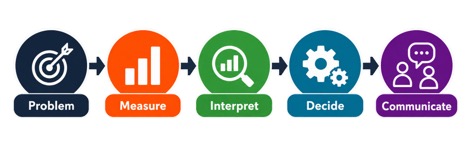
- Start with the problem that needs to be solved.
- Select a measure that addresses it.
- Interpret the result within the context of the athlete and environment.
- Determine whether it should influence a decision.
- Then communicate what matters in a way the athlete, coach, or staff can understand and use.
Not every measurement needs to result in a change to the program. Sometimes the appropriate decision is to continue what is already being done. The important part is knowing why something is being measured in the first place.
Consider the Cost of Measurement
Every measurement also has a cost.
The financial side is usually the easiest to recognize. Equipment can be expensive, and software subscriptions, maintenance, staff education, and data storage can add to that investment. There are practical costs as well. Testing takes time. Results have to be reviewed. Athletes need to understand the procedures. Coaches need enough familiarity with the system to recognize what the results do, and do not, tell them.
Validity and reliability also need to be considered at the level of the specific measure, not simply the device itself. Research examining commercially available wearables illustrates this well: measurement accuracy can differ depending on both the device and the variable being measured (Fuller et al., 2020). A technology may perform well for one outcome without being equally dependable for another.
Similar considerations apply to more sophisticated testing systems. Research comparing commercial force-plate systems has shown that reliability and agreement can vary across CMJ metrics, while differences in metric definitions and analysis procedures can complicate comparisons between systems (Merrigan et al., 2024). A number changing on a dashboard does not necessarily mean the athlete has meaningfully changed. Coaches still have to consider the size and consistency of the change, the reliability of the metric, and the conditions surrounding the assessment.
Feasibility matters too.
First-responder testing provides a good example. Assessments can be conducted inside station bays using a minimal setup, with personnel from multi-station departments rotating through a centralized testing location to minimize operational disruption (“Bringing Structure,” 2026). In that environment, an assessment protocol requiring extensive equipment, large amounts of time, or unrealistic staffing may be difficult to sustain regardless of how much data it produces.
A smaller testing battery that can be administered consistently may ultimately provide more practical value than a sophisticated protocol that is difficult to repeat.
Protect the Coaching Environment
The testing process also has to fit the coaching environment. If testing becomes overly time-consuming, athletes do not understand why it is being done, or the coach spends more time managing the technology than observing the people being coached, the process can quickly become counterproductive.
Technology can quantify performance characteristics that are difficult to judge consistently through observation alone. That is where it can be extremely useful. It still does not tell the whole story.
A poor test result can be meaningful, or it can simply be a poor test result. An unusual value may warrant action, or it may warrant another measurement. Coaches still need to understand the athlete, the testing conditions, the training that preceded the assessment, and the limitations of the technology being used.
Communication matters here as well. Even when a metric is useful to the coach, the athlete does not necessarily need every variable that appears on the dashboard. Athletes need to understand what is relevant to them and, when appropriate, what they can do with it. Sometimes that may require a detailed report. Other times, a short conversation about what changed and what will be addressed next is enough.
Before Adding the Next Device
Coaches already have access to more performance data than most programs could reasonably use. The challenge is deciding what deserves their attention.
Before introducing the next device, platform, or assessment into a coaching environment, several questions are worth asking:
- What problem does this solve?
- What does it measure?
- Is that measurement valid and reliable enough for its intended use?
- What decision could this change?
- Who needs to see the result?
- What happens when the result changes?
If those questions are difficult to answer, the program may not need another metric yet.
Technology has an important place in modern coaching. But collecting data is only the beginning. Coaches still have to understand what they are measuring, recognize its limitations, and decide whether the result matters enough to change what they do.